Monday, January 2, 2012

The Love of Moss - Part 1

I took a stroll in the woods last week on a rainy day in December. I didn't expect to see many birds or bees. I certainly wasn't expecting any flowers, and it was midday, so I expected the beavers would all be sleeping. I'm happy to report that my expectations were met - I saw nothing. At least that's what I fear many people would say had they taken the same walk. I'm a bit atypical, so I ended up staying out far longer than I expected. I was moss-watching.

Moss is some of the easiest wildlife to observe. This patch didn't even try to get away from me.

I've always loved moss. Perhaps it's because its physiology is so primitive, being based on a design about half a billion years old. Maybe it's because its texture and colors are a study in greens beyond the works of any human artist. Or, most likely, it's because you can find a hundred dramatic examples of moss in a few acres of woods on a rainy December day in northern Michigan when not much else is going on.

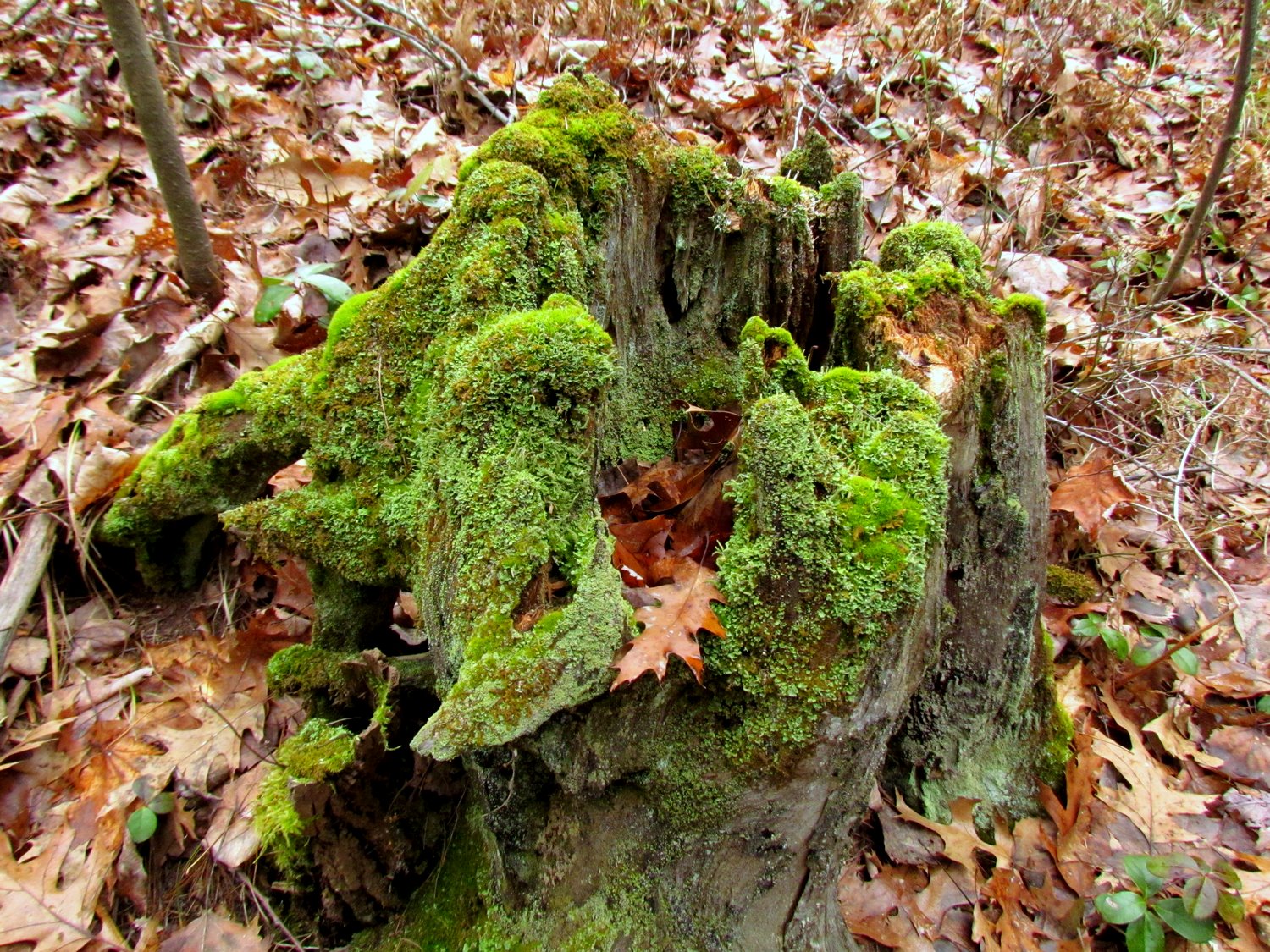
This stump appears to be being consumed by moss.


A fallen log enshrouded with moss, as is its stump. How many times was this scene repeated  in just a few acres?

Dozens.

This moss (Hypnum sp. ?) is exploding out of a hole in the log.


Here's some lichens joining the moss. Probably Cladonia sp.

Cladonia macilenta. A lichen called "Lipstick Powderhorn" by some.


Cladonia macilenta again.

You'll notice I don't even attempt to identify the moss and lichens in many of these pictures, while in others I make only a guess. Does this mean I don't know what I'm talking about? Yes. Yes, it does. I'll talk a little about moss identification in the next installment. It's a horror story.

All photos here were taken by me near Big Bear Lake in Otsego County, Michigan.

Wednesday, December 28, 2011

My 2012 eBird Challenge!


I've got a challenge for all you birders out there that involves nothing more than you, your binoculars, your favorite field guide, and eBird.

This Hairy Woodpecker is listening...


What is this eBird thing, you ask. Let’s allow the folks at eBird themselves to answer:

“A real-time, online checklist program, eBird has revolutionized the way that the birding community reports and accesses information about birds. Launched in 2002 by the Cornell Lab of Ornithology and National Audubon Society, eBird provides rich data sources for basic information on bird abundance and distribution at a variety of spatial and temporal scales.”

Some ducks from my life list. A life list is like a collection of awesome memories, isn't it?


Reduced to its most basic utility, eBird is a fun and convenient way to maintain your personal birding lists. Your life list, year lists, month lists, and numerous geographic lists are there for your perusal and updated automatically every time you enter a bird sighting. Have you seen more birds in Comnache County, Oklahoma or Grand Isle County, Vermont? eBird can tell you in a second, as well as every sighting you’ve ever had at specific locations in those counties.

My county lists. County birding is soooo much easier with eBird.


That can be a lot of fun, but it’s also a treat to use eBird to help locate birds. Let’s say you find yourself in southern Arizona in September of 2011 and you want to add a Lucy’s Warbler to your life list. Have any been seen in the area this month, and if so, where? A quick check of eBird reveals the answers.

Lucy's Warbler sightings in south-central Arizona in September 2011. (eBird screen shot)


If all of that isn’t enough, consider that every sighting you enter at eBird is a contribution to science. Ornithologists use the data collected there for myriad reasons, not the least of which could be in studies to determine migration and nesting patterns and the need to protect vulnerable habitat. It’s one of the finest examples of citizen science you can find. If you’re a birder, you are a citizen and a scientist already, you know.

Happy Scientist.


Consider this: You’re on a leisurely sea kayak trip on an early fall day. You’ve paddled out to False Cape State Park in Virginia and put-in for lunch on the barrier island’s beach. There you spot a pair of Buff-breasted Sandpipers. No other humans are in sight. You are now the sole possessor of some data. The species of bird, number of individuals, precise location, and time and date of appearance are all data that you, and only you, possess. Feeling some responsibility to share this newfound treasure? You should be! When those data are entered at eBird along with all the other sightings of Buff-breasted Sanpipers for the fall, a picture (literally!) of that species’ fall migration appears. Your sighting alone may seem insignificant, and it’s true that the vast majority of bird observation data are not very valuable in a vacuum. But combine those with millions of other records and the existing data become stronger and stronger with every new entry.

"Here's what I want you to do..."

So, here’s my challenge to you. If you haven’t signed up at eBird or haven’t used it much, I’d like you to become an active user and try to enter at least 365 checklists in 2012. But that’s a checklist for every day of the year, you cry! Yes, but it’s not as difficult as you’d think. (For one thing, there are 366 days in 2012, so it’s not even one per day, but that’s splitting hairs.) With jobs and kids and life and weather it’s impossible to go birding every single day of the year. But 365 checklists doesn’t mean 365 days. I entered twelve checklists for one 6-hour birding trip in November this year. These aren’t day lists, but rather checklists of sightings at fairly specific locations for relatively short periods of time.

Here are some tricks to easily get to 365.

One way is to enter Sunday yard birds. Spend 15 minutes counting birds in your yard every Sunday morning. Who doesn’t love relaxing like that? And with virtually no effort, you have 52 checklists for the year without leaving the house.

Birding doesn't have to be an adventure every time.
aka Gratuitous Angelina Jolie picture to generate blog visits.


You also have to start appreciating, and recording the seemingly mundane lists. Do you pass a pond on the way to work every morning? On most mornings does it have a few Mallards and a Great Blue Heron? In most of the country that would be something to yawn at. At eBird, that’s valuable information. Stop for five minutes, see what else you see, and enter the list! Who cares if the ducks and heron are all that’s on the list? Those are data that serve to make the entire body of data more valuable. A five or ten minute observation is all it takes. Two hundred of those counts may total about 20 hours of your entire year.  Is 20 hours spent watching birds in nature all that bad?

Common as dirt...and you should count 'em and list 'em!


And now you only need about a hundred more lists to hit the goal. If you go out actually birding once a week, and enter an average of two checklists for a morning bird walk, you’re going to hit the goal. If you take a weekend drive, ten lists in a day isn’t uncommon.

And we haven’t even added in the incidental sightings while driving or looking out the window of a restaurant. We birders like to say that we’re always birding, at least while awake. If that’s the case, 365 lists at eBird in 2012 should be a piece of cake.

Do it for the ornithologists. Do it for you. But most importantly, do it for the birds. Are you up for this challenge?

Comment below and let me know if you're in!

Monday, December 19, 2011

Grebe Feet!

ed. note: Today, we have a guest blogger from the land of Florida, David Peterson. I invited him to join us after he showed me the coolest photo of grebe feet in action I've ever seen!


Horned Grebe in winter plumage (Photo by David Peterson)
After running a few errands today, I stopped at a local beach, called Hudson Beach (officially Robert J. Strickland Memorial Park). I wasn't really expecting much more than to relax and enjoy the day, when a walk along the seawall gave me a very pleasant surprise. A little horned grebe was fishing right along shore, and did not seem to mind me walking up and down the seawall trying to get a couple pictures of it. I must have taken about a hundred photos, but I missed at least that many opportunities for more because I simply enjoyed watching it and forgot to point the camera. I was enthralled for over an hour.


Horned Grebe (Photo by David Peterson)


Then, while in pursuit of some small silvery fish, it came quite close, and I snapped a bunch of photos while it was diving underwater. When it went further away from shore again, I stopped and checked to see if any had turned out, you should have seen me—I literally jumped and gave a hoot, with the fist-pump and everything! A couple people looked at me like I was weird and one guy just chuckled away at me but gave me a thumbs-up. What can I say? I like grebes! And Grebe-Feet are just so cool!

Grebe Feet!  (Photo by David Peterson)

David Peterson hails from Port Richey, Florida, though he is quick to point out he's originally "from Wisconsin."  He sits on the board of the Nature Coast Chapter of the Florida Native Plant Society.

Best Bird of the Year

The good folks at 10,000 Birds are soliciting stories about everyone's "best bird of the year". That gave me a good excuse to avoid more productive work and relive a great twelve months of birding. Best Bird is quite an honor and not to be bestowed lightly.

Was it the Black-crowned Night Heron in Big Cypress National Preserve on the third day of the year? I'd been oddly missing that relatively common heron from my life-list. (And he had only one foot - a sentimental favorite.) Likewise I finally got an incredible Snowy Owl at Tawas Point State Park in Michigan just last week. Then there was the life Mourning Warbler at Magee Marsh in Ohio during the holy season of spring migration. Who could forget the Bobolinks lining the fence posts in Canaan Valley in West Virginia, singing like an army of R2-D2's? Even the Black Vultures in Everglades National Park that seemed intent on eating our windshield wipers were pretty special.

But I think the "best bird" is the one that stirs the birder's heart the most. In that case, the choice is clear.

McCormick Tract (Photo: Sue Wolfe)

On a cold November morning a few weeks ago, the western Upper Peninsula of Michigan had just received its first snow of the year, and it was a good one. The North Country Trail was covered with 18 inches of white powder as it sliced through the wild McCormick Tract, an hour west of Marquette in some of the UP's most beautiful, if not wholly pristine wilderness.

The North Country Trail (Photo: Sue Wolfe)


Here we found Gray Jays. Some folks call them Canadian Jays. Others call them "camp robbers" with good reason. Many northerners know them as the Whiskey Jack. This is an  Anglicized form of the name Wisakedjak, who was a trickster god of Algonquian mythology. (Supposedly Wisakedjak caused a flood that destroyed the world, which seems like more than an annoying prank, but who am I to judge?)

My name is Perisoreus canadensis. (Photo: Sue Wolfe)


Gray Jays are well known for being quite friendly around humans, particularly those who offer crumbs of blueberry muffin.

Sarah and a new friend. (Photo: Sue Wolfe)
Spotting a Gray Jay or two on a snowy morning in Northern Michigan is nothing out of the ordinary, but it brought back memories of my life Gray Jay.

 It was the summer of 2010, and my wife Sarah and I were exploring Newfoundland, which was becoming our favorite spot in the world. Having boned up on the potential new birds we'd see, we both reacted excitedly when something looking like a giant chickadee appeared in a spruce in Terra Nova National Park. A Gray Jay! We'd just nabbed our life Boreal Chickadees and were about to cavort with whales and icebergs. We'd spent the previous day watching thousands of Northern Gannets plunge-diving among spouting fin whales off of Cape St. Mary's. Life was good.


The lifer Gray Jay in Terra Nova National Park, Newfoundland. (photo: Kirby Adams)


Newfoundland was all about wonder. A new place to explore, new birds to see, new oceans to smell. A sating of the wanderlust, if such a thing is possible.  Life and its cohorts (time and money) conspired to keep us away from that rocky island in the North Atlantic this year.

Then a Gray Jay landed on Sarah's hand and for just a moment we were back in Terra Nova. I couldn't help but thank him.

Sunday, November 27, 2011

Beaver Activity Ramping Up

There's a beaver pond not far from our house that provides a tranquil spot to enjoy nature on most days. It's surrounded by some ancient red pine and beds of fabulous moss. The pond itself is home to Great Blue Herons all summer. But now that fall is looking to turn into winter, the beavers have turned some areas a hundred yards away from the pond into construction zones. I haven't had the pleasure of actually seeing a beaver at work here, but the evidence of their nightly engineering is fascinating.

The pond with primary lodge back in September.
Now, in late November, dam and lodge winterizing is in full swing.


The bark is often eaten.

Sawing the log into manageable (and edible) pieces.

At first glance, you'd swear a lumberjack had done this.

A log slide down to the pond. There are more than a dozen of these around the pond, all leading to a lumbering site on the elevated area far from the pond.

Beavers are legendary for their ability to react to the sound of running water and immediately patch a breach in their dam. At one point some researchers put a tape recorder with running water sounds in the middle of a field. Some nearby beavers quickly covered it with mud and bark. Does this prove you don't have to be bright to be a good engineer?

Castor canadensis. Photo by Steve.


Sunday, November 20, 2011

Birding and more on the Mission Peninsula


[It's been way too long since I updated this thing. I hope to correct that by being less of a perfectionist about long, involved posts, and just tell you about some cool stuff I've found. I know I shouldn't sacrifice quality for quantity, but I'm guessing you'd like to have at least some quantity!]

Ask a Michigander where he lives and he’ll proudly use the palm of his right hand as a map to point out the location. The lower peninsula of Michigan is shaped remarkably like a hand, with Saginaw Bay the opening between the thumb and index finger and the tip of the middle finger the spot where the Mackinaw Bridge crosses the straits to the Upper Peninsula. If we take the hand/map analogy a bit further, we could imagine a bay between the pinky and ring finger slicing due south into the west coast of Michigan. This is Grand Traverse Bay.


Jutting out from Traverse City at the base of the bay is a thin sliver of land that extends northward for 18 miles, splitting Grand Traverse Bay into two arms. This is the Old Mission Peninsula, a cluster of small farms, vineyards, and wineries. At the very tip lies a largely undeveloped area, Lighthouse Park. Two sand spits extend several hundred meters north from the end of the peninsula. The spits and the surrounding shallow water and mudflats make for excellent birding in almost any season.

Looking through my lists, I’ve nabbed my lifers of Greater Yellowlegs, Pectoral Sandpiper, Solitary Sandpiper, American Golden Plover, Least Sandpiper, White-rumped Sandpiper, and Orange-crowned Warbler here over the last few years. (eBird makes looking these things up so easy!)  My skills and ambition for birding are greater than for photography (so far), thus you’re stuck with more scenics than birds for the photos here.
Looking south from the tip of the eastern spit.

If you put your face really close to the screen (or click on it to make it bigger), you'll spot a Greater Yellowlegs.
I love the varied habitat here.

Killdeer nesting among the rocks.
(This was taken at a respectful distance.
Nesting birds should never be approached.)
Walking the spits in the spring is a delightful stroll as you’re serenaded by song sparrows, yellow warblers, and red-winged blackbirds, all the while scanning the mudflat for nearly invisible shorebirds. Invisible, that is, until you get your eyes in “shorebird mode” and realize there are dozens or hundreds of the little characters walking around. The path through the woods between the two spits passes some enormous oak, pine, and spruce. There’s lots of good woodpecker and forest bird action here, not to mention tons of moss, ferns, and lichens for the botanists.


The Mission Peninsula makes a great day of adventure. Bird the sand spits in the morning, do some wine tasting at stops like 2Lads Winery, grab a lakeside dinner, and return to the point for sunset. Just be careful of the zebra mussels. Bare feet and sharp mollusks are a bad combination.

Yay for imaginary lines!