Thursday, April 28, 2011

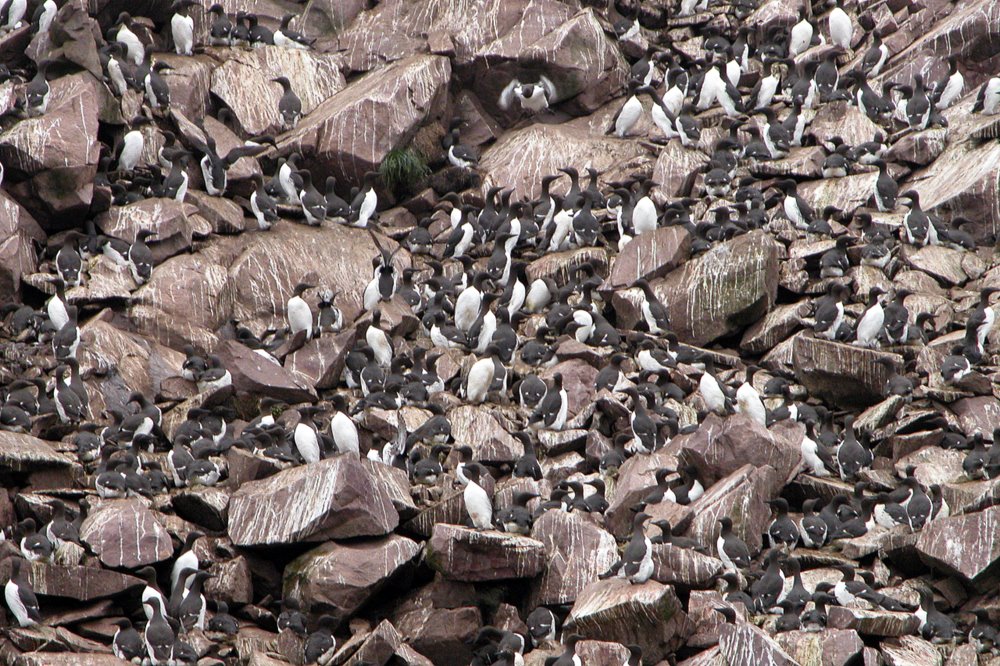
Witless Bay, Newfoundland - Under Development Threat

Sarah and I have spent some of the best times of our lives on the island of Newfoundland the last couple of summers. While every inch of that rugged island speaks to me in a way no other land does, the seabird colonies off the Avalon Peninsula are particularly special places to us. One of those, Witless Bay Ecological Reserve, is under threat. A planned development would illuminate one of the dark sections of beach on the mainland adjacent to the four islands of the reserve.

Here's a post about it at the ABA Blog.

Murres at Witless Bay

Here's a link to our photos from Witless Bay.

Search Amazon.com for Witless Bay

Thursday, April 21, 2011

Owl/Hawk/Snake Death Match

Whenever I go out on a short walk in the woods (or any other habitat) I usually have a particular thing in mind that I’m hoping to see.  It could be a certain flower that should be blooming, a bird that should be in the area, or even a black bear or something else grandiose.  The wonderful thing about this habit is that I never see the thing that occupies my mind’s “to-see” list.  Never.  And that’s perfectly fine with me.  The most interesting finds in your life will always be the ones unlooked for.


So, I went out to the woods (Woldumar Nature Center) for a couple hours today hoping to see a few of the first spring wildflowers our area has to offer.   All I ended up seeing was a Cooper’s Hawk fighting a pair of Barred Owls over possession of a big garter snake.  Yeah.  Didn’t see that coming.


It started off on the right foot.  I found a patch of white violets and a sprinkling of spring beauties.  (You see, I lied.  Sometimes I do find what I’m looking for.)  Then I got distracted by a Mourning Cloak Butterfly and started prancing after it to get a photo.  You will notice that there is no photo of a Mourning Cloak here.  That’s because just as it alighted on the leaf litter, the shadow of some giant, apocalyptic bird crossed the ground over the spot where it was resting.  I thought “red-tailed hawk” to myself, but I should have known better.  It was right over my head, flapping through the forest and there wasn’t even a whisper of a sound.  Owl.  It landed on a branch not far away and I admired it with the binoculars for a few moments before deciding to snap a picture.  There are no pictures of this owl here either.  That’s because just as I was about to snap one, a cacophony of Accipiterine anger filled the air.  I spotted another barred owl coming in with a crazed cooper’s hawk flying just above it, pecking at its back.  The second owl landed a few yards from the first, while the hawk landed a few more yards away. 

I lied again.  This is the first owl, but I didn't get this shot until later.

After a few more minutes passed, the first owl took off to a vantage point 8 or 10 trees away.  Second owl followed, and immediately the insane hawk starting squealing and followed.  And so it went, for about an hour.  At some point in there I noticed the second owl was holding a relatively large garter snake.  It moved the snake from bill to talon a couple times, then ultimately disappeared and returned moments later, snakeless.  I’m presuming the nest is nearby and there were some owlets looking forward to shredded snake tonight.


I’m not sure what the hawk thought he was doing.  I know this guy and know his nest site.  It’s about 200 yards away.  Seems too far to be this uptight about territory.  Maybe he wanted the snake?  There are two problems with that theory.  One, there were garter snakes everywhere on the forest floor.  No need to fight two owls twice your size to get one.  A foot-long snake literally crawled over my shoe while I was trying to be still and watch this drama unfold.  Two, the woods was also full of chickadees which most cooper’s hawks think are far tastier than snakes.  My theory is the hawk was nuts.


All the while I couldn’t help but marvel at how aware owls are.  I’ve never seen another bird that seems as calmly and thoroughly observant of its surroundings.  Every tiny movement or sound I made was noticed by the owls.  They also kept a very close eye on the hawk.  The second owl never lost concentration on the snake through the whole ordeal.  It was keenly aware of all of us: the other owl, the hawk, the snake, me, and the chipmunk 20 yards behind me under some leaves.  The bird probably knew where Jimmy Hoffa and D.B. Cooper were, but I didn’t care to ask.  I don’t usually like to be a player in the nature dramas I witness, but with owls there is no choice.


How’d everyone’s day end up?  The snake undoubtedly had the worst experience.  The hawk had to be frustrated.  I don’t know what he wanted, but I’m pretty sure he didn’t get it. The owls seemed to think it was just another day in the woods.  And me?  I remembered why I like to watch birds.  I remembered why I go to the woods.  An hour passed like a minute.  I felt like the most insignificant of characters in nature’s grand play.  And that is a beautiful thing to feel.

(Click on any photo above to see it bigger!)
Sunday, March 20, 2011

Waxwings Where They Belong - In a Cedar!


One of the joys of birding for me are those moments (frequent, thankfully) when I get to watch a bird just doing what that bird is supposed to be doing.  Now, I grant you that what they’re supposed to be doing is purely subjective and admittedly influenced by my misanthropic biases.  Nonetheless, I like to see birds doing what they did before we arrived and forced many of them (with the threat of extinction) to adapt to our presence.  Gulls feeding in garbage dumps, woodpeckers on feeders, and peregrines nesting on skyscrapers don’t entice me.  Sure, I’m happy they’ve adapted, but it doesn’t get my blood flowing when the birds are using human artifacts to get by in an altered world.  Eastern Phoebes may prefer bridges these days, but the phoebe that’s most special to me is the one I watched bringing food back to its nest in an overhanging rock beside a waterfall in a wooded ravine off the Youghiogheny River in Pennsylvania.  Show me a thrasher thrashing, a flicker flicking, and a creeper creeping.  And if you really want to make me happy, show me some Cedar Waxwings cavorting in a Cedar!  It doesn’t get any more proper than that!


Tuesday, February 22, 2011

The Sands of Time at Cape Romain

You don’t usually get to see geology “happening”.  The Appalachian Mountains were once higher than the Rockies are today, but no one has lived long enough to witness the peaks weathering down to comparative rolling hills, the once great mountains reduced to sand.  You can, however, see that very same sand changing the map daily on the Atlantic coast of North America.

Great Egrets over the Atlantic Surf on Bulls Island, South Carolina

Barrier islands are on the front lines of the war between the sea and land.  They protect estuaries, salt marshes, and calm channels on their back side, but the front face (in this case eastern and southern facing shores) is battered by the ocean.  The shape of the islands is constantly changing with every hurricane, every storm, and even every single wave, even on a calm day.  Sand just doesn’t tend to stay in one place.  In general, sand moves down the east coast of North America from north to south, island to island.  A barrier island like Bulls Island in South Carolina receives sand on its north shore from Cape Island to the north.  Meanwhile, it’s losing sand from its southern portion which is deposited on Dewees Island to the south.  Dewees, in turn, gives sand to Isle of Palms, which shares it with Sullivans Island, and so on.

Notice how each barrier island juts out on its northeast side where it receives sand and tails away on the southwest where it's losing ground.


Every hour of every day these islands are shifting.  When a storm comes along, like the massive Hurricane Hugo in 1989, the islands can be altered dramatically overnight, if not swept into the sea entirely.  But the process will start anew with a donation of sand from a neighbor to the north.

Boneyard Beach, Bulls Island, Cape Romain National Wildlife Refuge

The plant and animal communities on barrier islands must consequently be quick to adapt.  Most vegetation can adapt readily, and birds are versatile in nesting a few yards further up the shore year after year.  Trees don’t have the luxury of moving.  When a forest of oak, cedar, and pine suddenly finds itself with its feet in saltwater, it’s all over for the trees.  The result is something like the Boneyard Beach on Bulls Island.  A forest refuge for migrating warblers one day, a perch for cormorants in the surf the next.

Lone double-crested cormorant perched on a tree skeleton.
Brown Pelicans are common on Bulls Island.  They roost is large numbers two islands south in the marshes behind the highly developed Isle of Palms.

Bulls Island is protected as part of the Cape Romain National Wildlife Refuge.  This is a birder’s, botanist’s, and alligator-watcher’s paradise.  You can catch a boat ride out to Bulls island and spend the day there thanks to the folks at Coastal Expeditions in Mt. Pleasant, South Carolina.  If you really want to get intimate with a barrier island, hire a Coastal Expeditions guide for a barrier island kayak trip.  I can’t say enough good things about their guides.

The mouth of Jacks Creek, Bulls Island's "river". 


Thursday, February 17, 2011

Everglades Eye Candy, Anhinga Trail Flavor


A place called Anhinga Trail sounds like somewhere you’d go to see some birds.  At the very least, you’d expect to be rewarded with lots of Anhingas, right?  Well, I’m happy to report the Anhinga Trail does not disappoint.   Everglades National Park has been on our radar for a while and there was a star over this trail.  Sure, it’s known as the most heavily used trail in the park, but it sounded like it was worth dodging a little human traffic for the opportunity to see some cool birds.
Black Vultures awaiting our buddy Dave's death.  Dave waiting for vultures to move so he can photograph something else.

The diversity is stunning.  If you were building a zoo, you wouldn’t think of stuffing this many birds (not to mention a few dozen alligators) together in one place.  The floaters and the waders highlight the gentle half-mile walk.  All of the expected Florida herons make an appearance, as do the coots, grebes, ducks,  and moorhens.  Anhingas, cormorants, and vultures provide a constant backdrop.  Throw in a wood stork or two and you’re starting to get the idea of how crazy this place is. 
A wood stork lounging in a way that we humans might find painful.

Speaking of crazy, the black vultures here have been known to eat parts off of cars.  A few of them eyed up our rental Prius when we drove into the parking lot, so we wrapped the windshield wipers in scary crinkly plastic bags to protect the rubber.
Black Vulture

Most of the birds visible are black vultures.  A few turkey vultures as well.

As you walk the trail, you are literally arm’s length away from strolling vultures and sunning cormorants.  It’s a paved trail and boardwalk.  Not exactly a wilderness trail, but a blessing for those who can’t handle rough terrain for whatever reason.  The first couple hundred yards are atop a dike with a water-filled “ditch” (for lack of a better word) to one side.  Eventually, you turn out into the main waterway and traverse it on a boardwalk.
Green heron.  Always been one of my favorites.

Snack time for a pied-billed grebe.
The highlight of the trip was this American bittern emerging from the vegetation to look around.


Yes, there are plenty of Anhingas here as well.  Several tree-islands in the main marsh were filled with Anhinga nests.
Anhinga.  Our buddy Dave commented on how, in flame, these birds would be a perfect representation of the Phoenix.  Regardless, we didn't set any on fire.
This tree had three active Anhinga nests in it.
And it wouldn't be the everglades without alligators...
As we wrapped up our two-hour, three-quarter-mile walk the trail was starting to get crowded.  I was happy to be on my way out as so many people were starting to clog up the works.  One thing caught my eye, though.  There was a young girl, maybe 9 or 10 years old, looking through a giant pair of binoculars that she seemed barely able to hold up to her eyes.  “Daddy, is that a little blue heron?” she asked.  Her father scanned the area where she was looking and told her it was a tricolored heron and explained the subtle differences – subtle, at least, to a young kid.  The girl gobbled up the information with a big smile.  I remembered nature walks with my dad 30 years ago.  Love of nature may be innate, but it sure doesn’t hurt to nurture it in our young.  The world might just end up OK after all.
Tricolored heron says, "Thanks for caring."

Monday, February 14, 2011

A Buteo Valentine's Day!

Walking along the Red Cedar River this afternoon, I spied some crows harassing a red-tailed hawk as it flew over.  I silently wished the hawk well, commiserating about how it feels to have people/birds bother you everywhere you go.  A few minutes later, the hawk returned and perched about 20 yards away from me.  I slowly got closer to my new friend until I was as close as I felt comfortable, not wanting to scare it away from its new found peace.  For about an hour I stood mesmerized.  What a beautiful animal.


Thursday, February 10, 2011

Making Friends on Lopez Island

I had fair warning before landing on Lopez Island, but it still took me by surprise.  I’m not talking about the view of Mt. Baker, the abundance of marine life, or the fabulous birds.  No, it’s the waving that shocks you.  The island is proud of its reputation as an exceptionally friendly isle.  As you drive around, every passing motorist and every pedestrian waves a greeting at you, even if they have no clue who you are.  This isn’t as annoying as it may seem, since you really don’t see that many cars or people on Lopez.  In fact, after our first day there, we were waving at everyone as well.  (And if the wave wasn’t returned we’d just snort and mutter “tourists” under our breath.)  It’s one of those quirks that make islands so endearing.  Then there’s the birds, seals, surf, and Mt. Baker…
Mt. Baker from the ferry landing on Lopez Island.
 You may expect every location in northwest Washington to be wet and rainy, but that’s far from reality for many locations.  The San Juan Islands are heavily rain-shadowed by the highlands of the Olympic Peninsula and Vancouver Island.  While precipitation exceeding 250cm (100 in.) per year is common on the coast, Lopez Island receives only a fraction of that, about 50-70cm (20-30in.) 
The Salish Sea area.

The principle islands of the San Juan Islands.
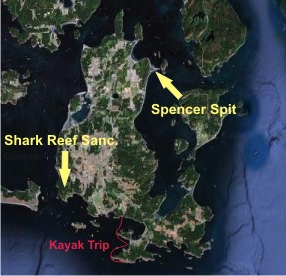
In our brief stay on Lopez Island we explored two areas by land (Shark Reef Sanctuary in the south, and Spencer Spit State Park in the north) and kayaked around Iceberg Point at the southern tip of the island.
Lopez Island
 Shark Reef Sanctuary is an extra-special place on an island full of special places.  The ideal spot to watch the sun set, Shark Reef is also one of the best wildlife viewing spots in the park.  We spent an afternoon and evening watching the seals on a rocky islet just off shore.
View from Shark Reef Sanctuary.  The Olympic Mountains can be seen in the distance.
 The seals were joined by an army of gulls and terns that included several Heermann’s Gulls (Larus heermanni).  A female harlequin duck drifted through the kelp beds just below the cliffs we perched upon.  We even got a bit of a jolt when we heard some exceptionally loud wing beats just a few feet above our heads.  A bald eagle had taken off from the low trees just behind us and landed out on the islet.  Sarah managed to see a pair of Pileated Woodpeckers on the walk back through the Salal-bottomed forest.
Sunset at Shark Reef.
Spencer Spit is a sandbar that juts out into Lopez Sound toward Frost Island.  The stroll out to the tip of the spit is delightful.  The marshy lagoon area is closed to the public as much of it is critical bird habitat.  Bring a spotting scope or good binoculars to the spit and you can spend a whole day looking at birds.  One bird we didn’t expect to find out here was the Red Crossbill (Loxia curvirostra).  These are denizens of the mature conifer forests, but here was a pair cavorting among the algae on the sandbar.  Turns out this isn’t all that uncommon for crossbills.  They seem to like salty stuff – even the extent of chewing on road salt in the winter. 
Western Sandpipers (Calidris mauri)
  For our water-based adventures on Lopez we chose kayaking, and chose the folks at Cascadia Kayak Tours to guide us.  Colin, the co-owner of Cascadia was our guide as we paddled around the southwestern parts of the island.  The rocky shore takes on a whole new dimension when you’re looking up from water level.
Colin from Cascadia Kayak Tours.  Our guide for the day.
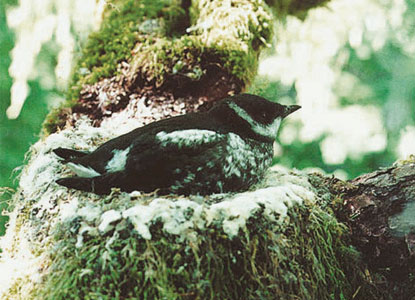
 Colin even managed to get us out far enough that we spotted some Marbled Murrelets (Brachramphus marmoratus) floating on the waters of the Strait of Juan de Fuca.   These endangered birds are alcids, relatives of the puffins and murres, but unlike other alcids they nest in old growth forest rather than colonies on rocky islets.  That’s where the endangered part comes in.  Their nesting habitat is disappearing rapidly. 
Who needs solid ground?  A Great Blue Heron standing on floating kelp.
  Our only regret about visiting the San Juan Islands is that we never got past Lopez!  A return trip to explore the other islands - Orcas in particular - is certainly in order.
Want a great guide to natural areas of the San Juan Islands?  Get a hold of this book:
Click the book to see it at Amazon!

If you want an awesome kayaking adventure, click here: