Sunday, November 27, 2011

Beaver Activity Ramping Up

There's a beaver pond not far from our house that provides a tranquil spot to enjoy nature on most days. It's surrounded by some ancient red pine and beds of fabulous moss. The pond itself is home to Great Blue Herons all summer. But now that fall is looking to turn into winter, the beavers have turned some areas a hundred yards away from the pond into construction zones. I haven't had the pleasure of actually seeing a beaver at work here, but the evidence of their nightly engineering is fascinating.

The pond with primary lodge back in September.
Now, in late November, dam and lodge winterizing is in full swing.


The bark is often eaten.

Sawing the log into manageable (and edible) pieces.

At first glance, you'd swear a lumberjack had done this.

A log slide down to the pond. There are more than a dozen of these around the pond, all leading to a lumbering site on the elevated area far from the pond.

Beavers are legendary for their ability to react to the sound of running water and immediately patch a breach in their dam. At one point some researchers put a tape recorder with running water sounds in the middle of a field. Some nearby beavers quickly covered it with mud and bark. Does this prove you don't have to be bright to be a good engineer?

Castor canadensis. Photo by Steve.


Sunday, November 20, 2011

Birding and more on the Mission Peninsula


[It's been way too long since I updated this thing. I hope to correct that by being less of a perfectionist about long, involved posts, and just tell you about some cool stuff I've found. I know I shouldn't sacrifice quality for quantity, but I'm guessing you'd like to have at least some quantity!]

Ask a Michigander where he lives and he’ll proudly use the palm of his right hand as a map to point out the location. The lower peninsula of Michigan is shaped remarkably like a hand, with Saginaw Bay the opening between the thumb and index finger and the tip of the middle finger the spot where the Mackinaw Bridge crosses the straits to the Upper Peninsula. If we take the hand/map analogy a bit further, we could imagine a bay between the pinky and ring finger slicing due south into the west coast of Michigan. This is Grand Traverse Bay.


Jutting out from Traverse City at the base of the bay is a thin sliver of land that extends northward for 18 miles, splitting Grand Traverse Bay into two arms. This is the Old Mission Peninsula, a cluster of small farms, vineyards, and wineries. At the very tip lies a largely undeveloped area, Lighthouse Park. Two sand spits extend several hundred meters north from the end of the peninsula. The spits and the surrounding shallow water and mudflats make for excellent birding in almost any season.

Looking through my lists, I’ve nabbed my lifers of Greater Yellowlegs, Pectoral Sandpiper, Solitary Sandpiper, American Golden Plover, Least Sandpiper, White-rumped Sandpiper, and Orange-crowned Warbler here over the last few years. (eBird makes looking these things up so easy!)  My skills and ambition for birding are greater than for photography (so far), thus you’re stuck with more scenics than birds for the photos here.
Looking south from the tip of the eastern spit.

If you put your face really close to the screen (or click on it to make it bigger), you'll spot a Greater Yellowlegs.
I love the varied habitat here.

Killdeer nesting among the rocks.
(This was taken at a respectful distance.
Nesting birds should never be approached.)
Walking the spits in the spring is a delightful stroll as you’re serenaded by song sparrows, yellow warblers, and red-winged blackbirds, all the while scanning the mudflat for nearly invisible shorebirds. Invisible, that is, until you get your eyes in “shorebird mode” and realize there are dozens or hundreds of the little characters walking around. The path through the woods between the two spits passes some enormous oak, pine, and spruce. There’s lots of good woodpecker and forest bird action here, not to mention tons of moss, ferns, and lichens for the botanists.


The Mission Peninsula makes a great day of adventure. Bird the sand spits in the morning, do some wine tasting at stops like 2Lads Winery, grab a lakeside dinner, and return to the point for sunset. Just be careful of the zebra mussels. Bare feet and sharp mollusks are a bad combination.

Yay for imaginary lines!

Thursday, June 16, 2011

Birding Canaan Valley National Wildlife Refuge in West Virginia

Thoughts from the Canaan Valley Birding Festival

Canaan Valley State Park

By the first week of June the songbird migration is wrapping up across most of the Great Lakes region where we happen to make our home. The birding festivals have mostly come and gone. Famous migrant-traps like Magee Marsh in Ohio have a scattering of nesting Yellow and Prothonotary Warblers where just two weeks earlier there had been 20 or more species of warblers cavorting along every hundred yards of the boardwalk. Having not had enough birds or birding yet, Sarah and I stuffed the Prius full of gear and headed to West Virginia for the Canaan Valley Birding Festival.

I guess this fest used to be called the Southern Boreal Birding Festival, but changed its name this year. I like the new name better as it's more representative of the area. The Canaan Valley is one of those spots that defies description with mere words. Just north of the highest peaks in West Virginia, there's a flat plain nestled between Canaan Mountain to the west and Cabin Mountain to the east. This is Canaan Valley (pronounced ka-NANE). In this region of the Appalachians, the mountains are long ridges running north/south with various peaks and saddles. Elevations of the ridges are roughly 4,000ft, give or take a few hundred. The valley floor is about 3,200ft.

Canaan mountain from the Canaan Valley floor


We pulled into Canaan Valley State Park and were immediately offered an auspicious sight: a gorgeous Northern Harrier (Circus cyaneus) sitting beside the park road. We'd go out the next morning and get to watch him hunt over an open field for a while before a couple crows drove him off. The festival began in earnest the afternoon of Friday, June 3rd, so we took the opportunity of a morning off to head north 10 or 12 miles to Blackwater Falls State Park. The scenery was stunning as usual. The dead and dying hemlocks a sad sight, the birding difficult. Having just watched the spectacle that is May migration, it's tough to start looking for warblers hiding on territory in dense deciduous vegetation. Nevertheless, we did get a great sighting of a Blue-headed Vireo (Vireo solitarius) that posed for us under a red spruce near Blackwater Falls.

Blackwater Falls, Blackwater Falls State Park

Friday's afternoon walk back at Canaan netted another awesome Blue-headed Vireo as well as a Black-billed Cuckoo. All the other usual suspects were present, including birds we in Michigan consider northern species like Dark-eyed Juncos (Junco hymenlais). After watching the Juncos move north out of lower Michigan in April, it was weird to drive south to West Virginia and find them nesting. That's the beauty of a varied elevation. We also got to spot some nice fern diversity in the forests on the plain of the valley.
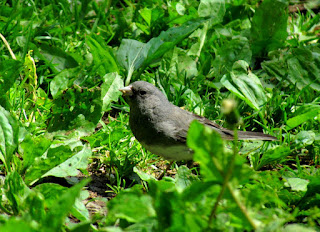
Dark-eyed Junco (Junco hymenalis)

Saturday morning's excursion took us to the Stuart Recreation Area of Monongahela National Forest. (That's ma-NON-ga-HEY-la, a really beautiful word to say once you get used to it!) We climbed up to about 4,400 feet and heard many warblers, but had trouble actually spotting any. There was great open habitat for Golden-winged Warblers on the side of the mountain, but we only heard them and failed to see them. A beautiful Chestnut-sided Warbler did show himself, as did a nice Brown Thrasher and Scarlet Tanager. We heard a Blue-winged Warbler as well, but failed to find him - what would have been a lifer for Sarah and me as we count only birds that are visually confirmed. At the very top of the mountain, I did get a fleeting glimpse of a Mourning Warbler and managed a long look at a Red-eyed Vireo while waiting for the warbler to reappear. On the way down the mountain we saw the day's first Cerulean Warbler after hearing several as we went along. Frustration at hearing so many fine birds and seeing so few was setting in, but the view from the mountaintop and the glory of being deep in the Appalachian woods more than made up for it. (I mentioned too many birds in this paragraph to insert the scientific names of each one without making difficult to read. Ditto for the rest of the post. Forgive me!)

Climbing up the Stuart Rec Area

Birders search in vain for a singing Golden-winged Warbler

As afternoon rolled around, we were back in the valley to find some grassland birds. We toured a couple sites in the Canaan Valley National Wildlife Refuge where Bobolinks, Eastern Meadowlarks, Grasshopper Sparrows, and Vesper Sparrows were common. The Henslow's Sparrow eluded us. After this tour we struck out on our own to see what we could see. Dinner was the first stop, but my delicious roast beef at Big John's Family Fixin's was interrupted by Sarah yelling that a Bittern was outside the window. Sure enough, an American Bittern had landed at the pond behind the restaurant and was commencing to hunt for whatever fish or frogs might be in there. Rejuvenated by the bittern and the roast beef, we headed back to a spot we'd spent only a minute or two at during the afternoon tour. This turned out to be our favorite spot of the trip, an iconic location in the Canaan Valley (in our opinion), and a candidate for being one of those places where your natural spirit knows it's found holy ground.

Canaan Valley National Wildlife Refuge - The Freeland Tract: A Very Special Place

Freeland Tract - Canaan Valley National Wildlife Refuge


The Freeland Tract of Canaan Valley National Wildlife Refuge is specially designated to be managed for the benefit of American Woodcock. While June is not a good time to find woodcock, we did see plenty of grassland birds, as well as a conglomeration of others among some withered pines surrounding some natural springs and pools. Cedar Waxwings adorned virtually every branch of some of the skeletal pines. Eastern Kingbirds and Willow Flycatchers flitted among the waxwings and the occasional Yellow Warbler made an appearance to sing about how sweet something was. We ended up seeing 16 species from one spot in the last hour before sunset.

Eastern Kingbird (Tyrannus tyrannus)

Sunday morning found me riding a chairlift to the top of Cabin Mountain, eyes tightly closed as I battled my rather severe acrophobia. It was raining and glorious atop the mountain as we walked the saddle over to a peak known as Bald Knob. (There's another Bald Knob, the second highest point in WV, but this is a different one.) After looking out over the Canaan Valley, we descended by foot, counting birdsong as we went. As had been the trend all weekend in the woods, many were heard, few were seen.

All-in-all it was a wonderful trip, as any trip to the highlands of West Virginia usually is. If you're content with hearing a lot more than you see, the Canaan Valley Birding Festival is worth a visit. We met some great birders from New York, New Jersey, Pennsylvania, and California. And even if you didn't see or hear a single bird, how can you not enjoy a view like this:

Freeland Tract - Canaan Valley National Wildlife Refuge

As with any post, click on the photos to see a larger size.


Tuesday, May 24, 2011

Kirtland's Warbler: Not Michigan's State Bird


The state bird of Michigan is the American Robin (Turdus migratorius). That’s all well and good, but a lot of bird admirers in this state think it would make more sense to bestow that honor upon the Kirtland’s Warbler. After all, the vast majority of these birds choose Michigan – and nowhere else - as the site for their summer nests. A handful (almost literally) call Wisconsin, Minnesota, and Ontario home, but those numbers are negligible compared to Michigan. That’s not to say there are millions of them here. Last year’s census counted only 1773 singing males in the jack pine forests of the northern Lower Peninsula of Michigan. Kirtland’s Warblers are protected under the Endangered Species Act, and with the assistance and cooperation of several agencies, the bird has recovered from a population of only a couple hundred pairs in the 1980’s.

Young Jack Pine habitat in Huron-Manistee National Forest, Michigan


Habitat
Kirtland’s Warbler utilizes the Jack Pine (Pinus banksiana) forests as nesting habitat. Pure stands of young jack pine are essential, as the warblers sing from atop trees that are between roughly 5 feet and 15 feet tall. The nests are built on the ground near the base of a tree, log, or other debris. Loss of habitat has been devastating to Kirtland’s Warblers, particularly that caused by suppression of wildfires that lead to a constant supply of pure stands of young pine. Today the US Forest Service manages for proper warbler habitat by planting Jack Pine plantations, conducting prescribed burns, and clear-cutting of selected mature pine forests. The warbler nesting grounds are closed to entry during breeding season, though the USFS and US Fish and Wildlife Service provide tours that virtually ensure a good spotting of a Kirtland’s Warbler.

Kirtland's Warbler (Dendroica kirtlandii)


An actual good picture of a Kirtland's Warbler courtesy of Bmajoros under a Creative Commons License.


Take a Tour
On a Kirtland’s Warbler tour you can expect to walk along a sandy forest service road listening for the melodic call of the warbler. Nashville Warblers (Vermivora ruficapilla) or Canada Warblers (Wilsonia Canadensis) may give a false alarm, but sooner or later, you’ll spot a Kirtland’s happily singing from atop a tiny pine. Like all warblers, they have a tendency to bounce around, but on the nesting grounds it’s not unusual for one to sing in one spot for several minutes. On our excursion this week we had plenty of time to point the scope at one male and watch him for a few minutes. Binoculars will be fine for most sightings, but if you have a scope, by all means take it along. The guides will often have scopes, but it never hurts to have your own equipment. As with any warblers, good photography will require a very long tripod-mounted lens and a bit of good luck. My shots are serviceable but certainly not quality.
The Dreaded Cowbird
One other threat to Kirtland’s Warblers is the expanding populations of the nest parasite Brown-headed Cowbird (Molothrus ater) that lays eggs in other birds’ nests after which the hatchling cowbirds overpower and kill some, if not all, of the resident hatchlings. In its traditional range, this parasitism is of little consequence to native birds. Cowbirds, however, are a recent addition to the forests of northern Michigan, having taken advantage of the massive clear-cutting of the last century. In order to manage for survival of the Kirtland’s Warbler, the US Fish and Wildlife Service traps Brown-headed Cowbirds at more than 50 sites throughout Kirtland’s habitat in the Huron National Forest. The cowbird removal appears to have helped warbler populations significantly.
Ecology, Ecology, Ecology

As with everything in nature, there’s more to the story than just the pines providing a spot for the warblers to live. The Jack Pine forests harbor a pine predator, the Jack Pine Budworm (Choristoneura pinus), a needle-eating Lepidopteran (caterpillar). During their breeding season, Kirtland’s Warblers have been shown to eat enormous quantities of these caterpillars, particularly when feeding their young. As Bay-breasted Warblers (Dendroica castanea) are known to do across the north with Spruce Budworm, it seems D. Kirtlandii is a natural control for Jack Pine Budworm.


Tours can be arranged through the US Forest Service from Mio, Michigan or the US Fish and Wildlife Service from Grayling, Michigan. On my tour, I was graced with guides from both of those agencies as well as the Michigan DNR. Thus I can’t speak to which tour would be better, but I doubt you can lose either way.

In Grayling you can even stay at the Warbler's Way. (I haven't stayed there; can't offer a review.)
In the interest of not ignoring the home of the Kirtland’s Warbler for most of the year, the Bahamas are a fairly nice spot to visit in January! Just as their summer breeding range is severely limited compared to that of most wood warblers, they winter only in the Bahama Islands, primarily on Eleuthera Island.  Eleuthera is over a hundred miles long and never more than a few miles wide. What “interior” there is has some pine forests and deep within these trees is where you’ll find (if you’re really looking) the Kirtland’s Warbler in winter. Eluthera is not as heavily developed as the inner Bahamas and makes for a great nature escape in winter.
Below are links to two great books and a nifty stuffed warbler (not a real one!)


Saturday, May 14, 2011

Nighthawk Crypsis Fail

If you're a Common Nighthawk (Chordeiles minor), you've evolved some amazing cryptic plumage that allows you to seamlessly evaporate into the twigs and leaves during the brightest daylight hours. So where do you crash for the day?

Common Nighthawk (Chordeiles minor) not quite hiding.

On a fully exposed branch of a willow tree hanging over a clearing, of course! We spotted this guy at the Cedar Point National Wildlife Refuge on a trip guided by Michael Retter of Tropical Birding. Cedar Point NWR is usually closed to visitation, but we got in on a special tour as part of the Biggest Week in American Birding.

Thursday, April 28, 2011

Witless Bay, Newfoundland - Under Development Threat

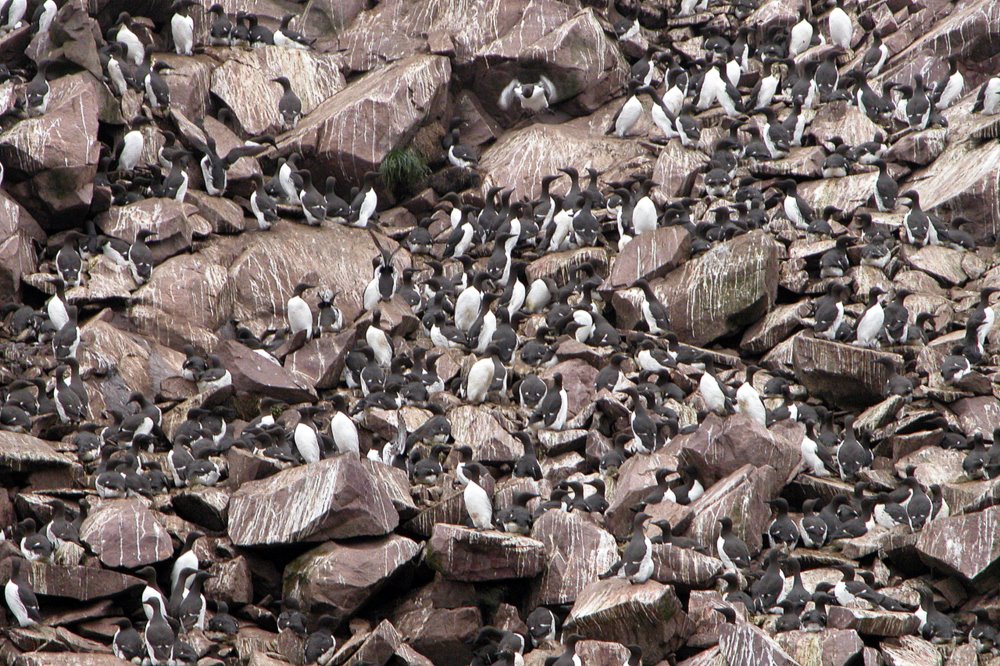
Sarah and I have spent some of the best times of our lives on the island of Newfoundland the last couple of summers. While every inch of that rugged island speaks to me in a way no other land does, the seabird colonies off the Avalon Peninsula are particularly special places to us. One of those, Witless Bay Ecological Reserve, is under threat. A planned development would illuminate one of the dark sections of beach on the mainland adjacent to the four islands of the reserve.

Here's a post about it at the ABA Blog.

Murres at Witless Bay

Here's a link to our photos from Witless Bay.

Search Amazon.com for Witless Bay

Thursday, April 21, 2011

Owl/Hawk/Snake Death Match

Whenever I go out on a short walk in the woods (or any other habitat) I usually have a particular thing in mind that I’m hoping to see.  It could be a certain flower that should be blooming, a bird that should be in the area, or even a black bear or something else grandiose.  The wonderful thing about this habit is that I never see the thing that occupies my mind’s “to-see” list.  Never.  And that’s perfectly fine with me.  The most interesting finds in your life will always be the ones unlooked for.


So, I went out to the woods (Woldumar Nature Center) for a couple hours today hoping to see a few of the first spring wildflowers our area has to offer.   All I ended up seeing was a Cooper’s Hawk fighting a pair of Barred Owls over possession of a big garter snake.  Yeah.  Didn’t see that coming.


It started off on the right foot.  I found a patch of white violets and a sprinkling of spring beauties.  (You see, I lied.  Sometimes I do find what I’m looking for.)  Then I got distracted by a Mourning Cloak Butterfly and started prancing after it to get a photo.  You will notice that there is no photo of a Mourning Cloak here.  That’s because just as it alighted on the leaf litter, the shadow of some giant, apocalyptic bird crossed the ground over the spot where it was resting.  I thought “red-tailed hawk” to myself, but I should have known better.  It was right over my head, flapping through the forest and there wasn’t even a whisper of a sound.  Owl.  It landed on a branch not far away and I admired it with the binoculars for a few moments before deciding to snap a picture.  There are no pictures of this owl here either.  That’s because just as I was about to snap one, a cacophony of Accipiterine anger filled the air.  I spotted another barred owl coming in with a crazed cooper’s hawk flying just above it, pecking at its back.  The second owl landed a few yards from the first, while the hawk landed a few more yards away. 

I lied again.  This is the first owl, but I didn't get this shot until later.

After a few more minutes passed, the first owl took off to a vantage point 8 or 10 trees away.  Second owl followed, and immediately the insane hawk starting squealing and followed.  And so it went, for about an hour.  At some point in there I noticed the second owl was holding a relatively large garter snake.  It moved the snake from bill to talon a couple times, then ultimately disappeared and returned moments later, snakeless.  I’m presuming the nest is nearby and there were some owlets looking forward to shredded snake tonight.


I’m not sure what the hawk thought he was doing.  I know this guy and know his nest site.  It’s about 200 yards away.  Seems too far to be this uptight about territory.  Maybe he wanted the snake?  There are two problems with that theory.  One, there were garter snakes everywhere on the forest floor.  No need to fight two owls twice your size to get one.  A foot-long snake literally crawled over my shoe while I was trying to be still and watch this drama unfold.  Two, the woods was also full of chickadees which most cooper’s hawks think are far tastier than snakes.  My theory is the hawk was nuts.


All the while I couldn’t help but marvel at how aware owls are.  I’ve never seen another bird that seems as calmly and thoroughly observant of its surroundings.  Every tiny movement or sound I made was noticed by the owls.  They also kept a very close eye on the hawk.  The second owl never lost concentration on the snake through the whole ordeal.  It was keenly aware of all of us: the other owl, the hawk, the snake, me, and the chipmunk 20 yards behind me under some leaves.  The bird probably knew where Jimmy Hoffa and D.B. Cooper were, but I didn’t care to ask.  I don’t usually like to be a player in the nature dramas I witness, but with owls there is no choice.


How’d everyone’s day end up?  The snake undoubtedly had the worst experience.  The hawk had to be frustrated.  I don’t know what he wanted, but I’m pretty sure he didn’t get it. The owls seemed to think it was just another day in the woods.  And me?  I remembered why I like to watch birds.  I remembered why I go to the woods.  An hour passed like a minute.  I felt like the most insignificant of characters in nature’s grand play.  And that is a beautiful thing to feel.

(Click on any photo above to see it bigger!)